
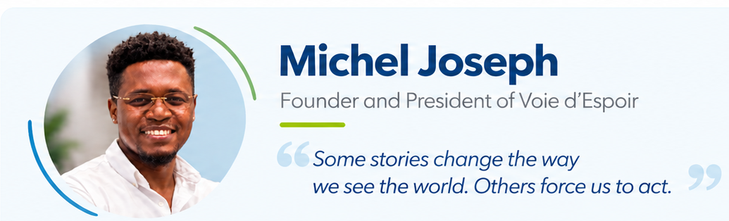
I never imagined that my career as a journalist would one day lead me to dedicate part of my life to the search for family origins. It all began with encounters, testimonies, and stories I initially thought I was simply there to tell.
But behind those reports, I discovered human realities that no camera could ever fully capture.
I met mothers who carefully preserved the last photograph they had of their child. Families who, after years of separation, continued to hope for a phone call, some news, or simply a sign of life. I also discovered the profound questions faced by people adopted abroad who had grown into adulthood with fragments of their personal history, unanswered questions, and one fundamental question: Where do I come from?
These encounters profoundly changed my perspective.
I came to understand that the distance separating families affected by adoption extended far beyond geographical borders. It was a distance marked by missing documents, incomplete memories, unanswered questions, but also by fear, anticipation, and hope.
Gradually, I realized that telling their stories was no longer enough. I felt a responsibility to help write what might come next.
Voie d’Espoir was born out of this conviction.
What began in 2015 as a journalistic initiative gradually became a personal commitment and, eventually, a collective endeavor. In 2020, that commitment took on a new dimension with the establishment of our organization.
I have never considered this mission an individual undertaking. It has been built upon the trust of families, the courage of adoptees who have embarked on the search for their origins, and the dedication of the women and men who have chosen to stand alongside us.
Throughout this journey, I have also learned something fundamental: finding someone does not necessarily mean rebuilding a relationship. Behind every search lies a unique story, sometimes painful, that requires patience, sensitivity, and profound respect for each person's choices.
Our responsibility, therefore, goes beyond reuniting people who have been separated. It also means searching for the truth with rigor, preserving the dignity of families, preparing potential reunions, and supporting everyone involved, even when their decisions differ from the reunions others may have hoped for.
Because knowing one's origins is a right. Reconnecting with one's family remains a choice.
This philosophy guides everything we do.
Through Voie d’Espoir, I also pursue a broader ambition: to give adoptees of Haitian origin the opportunity, should they wish, to reconnect with their country of birth, its history, its culture, and their identity. I want them to have the opportunity to discover Haiti beyond the circumstances of their adoption and to find their place within a history to which they belong.
I also envision a society in which biological families are no longer left waiting in silence and indifference. A society that recognizes their voices, preserves their testimonies, and provides meaningful opportunities to search for their loved ones.
Today, Voie d’Espoir has become far more than an extension of my early journalistic reports. It is a collective responsibility, carried forward by a dedicated team and partners who share our conviction: every person deserves the opportunity to access their own history.
We promise neither miracles nor reunions at any cost. We commit ourselves to searching, verifying, listening, and providing support with honesty, compassion, and respect.
I recognize how far we have come, but I remain even more aware of the journey that still lies ahead. As long as there are people searching for their origins and families waiting for answers, our mission will remain essential.
If journalism taught me to give a voice to those who are rarely heard, Voie d’Espoir taught me that sometimes we must go further: we must turn those voices into action and transform hope into a tangible possibility.
This is the commitment I have chosen to uphold. It is also the commitment I hope to pass on.