
Voie d’Espoir, Plan Kiskeya and WebHare Review Digital Platform for Searching for Origins in Haiti
A few weeks after the official launch of Voie d’Espoir’s new digital platform in Haiti, a working session was held on Friday, October 23, 2026, at the headquarters of WebHare in Enschede, the Netherlands. WebHare is the company responsible for developing the platform.
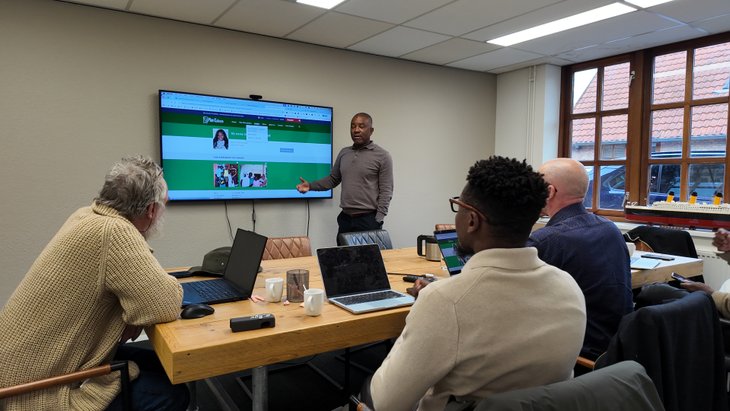
The meeting brought together representatives of Voie d’Espoir, Plan Kiskeya, and WebHare with a shared objective: to evaluate the platform’s first weeks of operation, review its various features, and identify improvements needed to make the tool more efficient, accessible, and better adapted to the realities of searching for origins in Haiti.
Beyond presenting Voie d’Espoir as an organization and highlighting its activities, the platform was designed as a practical working tool to support adoptees and biological families.
It includes a database that allows users to register profiles and centralize information relevant to family tracing. The working session therefore provided an opportunity to examine the database’s functionality, profile management, personal data protection, user experience, and the various tools available for website administration and content publishing.
Discussions also focused on several potential improvements aimed at facilitating navigation, strengthening data protection, and simplifying the work of the teams responsible for managing and updating the platform.
The Result of a Partnership Between Voie d’Espoir and Plan Kiskeya
Funded by INEA, the development of this digital platform is one of the concrete achievements of the partnership between Voie d’Espoir and Plan Kiskeya, a Dutch foundation established by people of Haitian origin who were adopted in the Netherlands.
Through this collaboration, the two organizations combine their experience, networks, and resources to strengthen mechanisms for searching for origins and facilitating family reconnection between Haiti and countries where Haitian children were adopted.
Voie d’Espoir works directly with biological families in Haiti, while Plan Kiskeya contributes its experience of the adoptee community and supports the development of mechanisms designed to facilitate searches, particularly through the RAPWOCHE/KONEKTE project.
This complementary approach is gradually building bridges between the two sides of the same story: adoptees searching for their origins and biological families who, sometimes for several decades, have been waiting for news of a child placed for adoption.
Technology in the Service of Human Stories
In the search for origins, access to information is often one of the greatest challenges. Documents may be incomplete, families may have moved to different regions, contact details may no longer be valid, and several decades may separate an adoption from the beginning of a search.
A structured digital platform makes it possible to centralize information more effectively, organize profiles, and facilitate verification and potential matches between searches initiated by adoptees and information provided by biological families.
However, a digital tool cannot replace field investigations, information verification, the consent of those concerned, or the human support required before any contact is established. Technology must primarily help organize and secure the search process while placing dignity, confidentiality, and respect for individuals at the heart of every step.
Evaluating the Platform to Continue Improving It
Just a few weeks after the platform went live, the meeting in Enschede represented an important opportunity to assess how the tool performs in real-world conditions. Feedback collected from Haiti, the needs of field teams, and the experiences of the first users now make it possible to identify necessary adjustments and consider additional features.
This commitment to continuous evaluation reflects a shared ambition: to make the platform an increasingly reliable and accessible tool for supporting the search for origins in Haiti and throughout the diaspora.
Voie d’Espoir continues to strengthen its tools and working methods so that technology can contribute to a profoundly human mission: helping people separated by adoption and the passage of time rediscover elements of their personal histories and, whenever circumstances allow, reconnect with their families.