
Voie d’Espoir and Plan Kiskeya Sign Agreements to Strengthen Cooperation in the Search for Origins
The collaboration between Voie d’Espoir and Plan Kiskeya has reached a new milestone. On Sunday, October 25, 2026, in the Netherlands, Michel Joseph, founder of Voie d’Espoir, and Judy Aubrain, founder of Plan Kiskeya, signed several agreements governing the exchange and protection of personal data. The signing aims to facilitate cooperation between the two organizations in supporting adoptees of Haitian origin and their biological families.
For several years, Voie d’Espoir, based in Haiti, and Plan Kiskeya, based in the Netherlands, have worked together to support adoptees of Haitian origin in their search for identity and biological family members. This collaboration draws on the complementary expertise of both organizations.
In Haiti, Voie d’Espoir is responsible for registering biological families, collecting testimonies, conducting field investigations, verifying information, and supporting families throughout the search and reconnection process. Plan Kiskeya, for its part, assists adoptees in their searches and contributes to family identification efforts, particularly through genealogical tools and DNA analysis.
The two organizations also collaborate through the RAPWOCHE/KONEKTE project, financially supported by INEA, the Dutch expertise center dedicated to intercountry adoption, identity, and post-adoption support. This project has made it possible to organize several awareness-raising activities, biological family registration initiatives, and DNA sample collection sessions in different regions of Haiti.
Throughout this collaboration, the two partners have developed coordination mechanisms to facilitate searches and support those involved in a process that requires rigor, confidentiality, and respect for individual choices.
Reciprocal Access to Databases Within a Regulated Framework
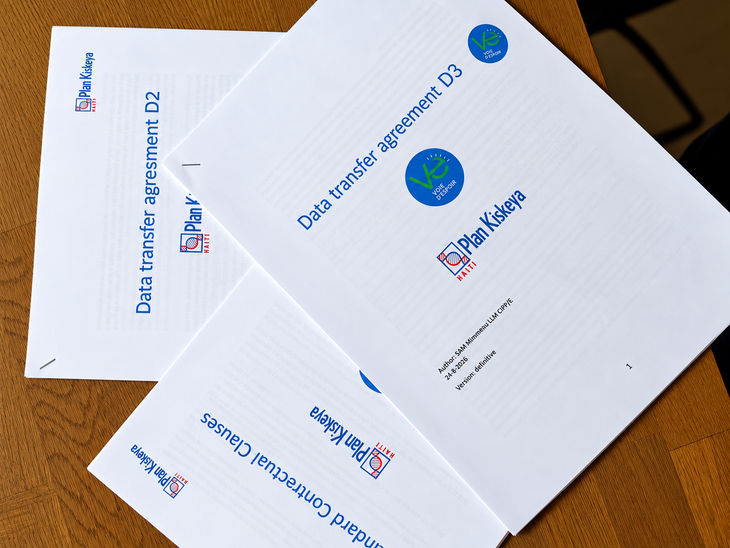
The agreements signed on October 25 include two data transfer agreements, designated D2 and D3, as well as standard contractual clauses concerning the protection of personal data. These documents have a specific purpose: to establish the conditions under which Voie d’Espoir and Plan Kiskeya may access information contained in each other's databases.
Agreement D2 governs the transfer of data from Plan Kiskeya in the Netherlands to Voie d’Espoir in Haiti. Conversely, Agreement D3 defines the conditions under which Voie d’Espoir grants Plan Kiskeya access to data held on its own platform. This arrangement is intended to facilitate the cross-referencing of information held by both organizations while defining their respective responsibilities for processing that information.
The agreements recognize both partners as joint data controllers for the processing operations concerned. The information covered includes identification details, photographs, information about the circumstances of adoption, details concerning biological and adoptive families, and certain data related to genetic searches. The sensitive nature of this information underscores the importance of the safeguards established in the signed documents.
Data Protection at the Heart of the Commitments
The agreements establish several rules concerning the use, retention, and security of shared information. They provide for data processing limited to defined purposes, controlled access to information, and provisions concerning the consent of the individuals involved. The protocol also specifies that consent must be renewed every two years.
The technical annexes describe various protective measures, including access rights management, secure authentication, encryption, data leak prevention, and security incident management. The documents also specify the conditions applicable when the cooperation ends, particularly regarding the return or deletion of data.
This formal framework is particularly important in the context of searches for origins, where case files may contain personal information collected several decades after an adoption. It seeks to balance the need to share information relevant to searches with the obligation to protect confidentiality and individual rights.
Facilitating Searches Between Haiti and Other Countries
For people adopted internationally, searching for their origins often involves overcoming the fragmentation of information across several countries, institutions, and intermediaries. In Haiti, some biological families hold information that does not appear in adoption records. Abroad, adoptees sometimes possess documents or details that may help guide field investigations.
Reciprocal and regulated access to the databases should enable the teams of both organizations to compare this information more effectively, identify potential matches, and coordinate their efforts. However, this does not mean that reunions can be guaranteed automatically. Every search requires verification, careful assessment of the available information, and respect for the consent of those involved.
This cooperation should also help improve the continuity of support, from initial requests to potential contact with located family members. The agreements were signed during a European mission aimed at strengthening Voie d’Espoir's relationships with its international partners and institutions working in the fields of adoption and the search for origins.
A few days earlier, on October 19, the organization had participated in a working meeting in the Netherlands with Plan Kiskeya and INEA. Discussions focused particularly on activities carried out in Haiti, the results of the RAPWOCHE/KONEKTE project, and prospects for future cooperation.
The October 25 signing adds a further contractual dimension to a partnership that is already active on the ground. For Voie d’Espoir and Plan Kiskeya, the challenge now is to continue these searches within a more structured framework, supported by shared procedures and safeguards appropriate to the sensitivity of the information being processed.
Behind these technical agreements lies a human reality: adoptees seeking to understand their personal histories and biological families who, sometimes for several decades, have hoped to find a child. By strengthening the framework for their collaboration, the two organizations aim to make these searches more coordinated, more reliable, and more respectful of everyone's rights.