
Search for Origins: Professionals Confront the Emotional Weight of Family Tracing
Joy, sadness, anticipation, disappointment, hope, regret… The search for origins is a world where sometimes conflicting emotions intersect with deeply moving human stories. For professionals supporting adoptees and biological families, the work goes far beyond finding information or re-establishing contact. It also requires the ability to listen, understand, and provide support as the search brings deeply rooted emotions to the surface.
Every day, Voie d’Espoir encounters unique stories. Some are filled with hope, while others are marked by decades of separation, silence, or uncertainty. There are mothers who have spent years waiting for news of a child placed for adoption. Adoptees seeking to understand the circumstances of their birth and separation from their biological families. Families hoping for reunions, but also others who fear the answers a search might uncover.
Sometimes, these searches lead to deeply emotional reunions. At other times, they reveal difficult realities, unexpected information, or absences that can never truly be filled.In this environment, professionals are called upon to listen to stories that may affect them profoundly. And sometimes, the human being behind the professional comes to the forefront.
A Discussion Session with Tom Hendriks on Psychosocial Support
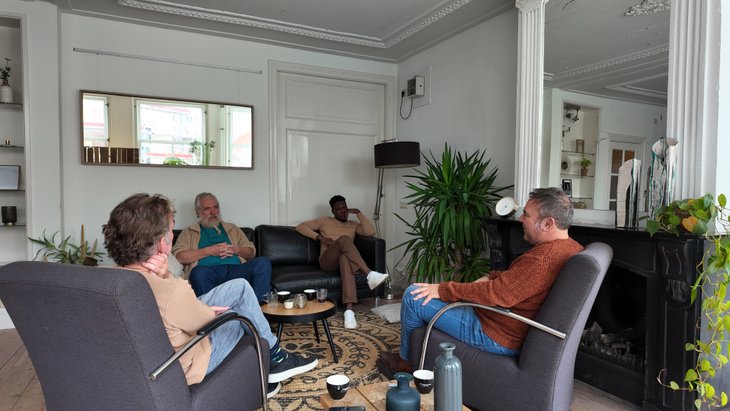
Against this backdrop, Michel Joseph, Founder and President of Voie d’Espoir, and Dirk Vermeyen, Supervisor for the Northern Region, participated in a discussion session on Thursday, October 22, 2026, with Tom Hendriks, an experienced specialist in counseling and support services at Fiom. Organized as part of Voie d’Espoir’s European mission, the meeting provided an opportunity to explore the psychological and emotional dimensions of searching for origins, as well as the challenges faced by professionals working with adoptees and biological families.
Through an interactive question-and-answer session, Voie d’Espoir’s representatives reflected on various situations encountered in their daily work in Haiti. The discussions focused particularly on professional conduct, active listening, managing expectations, respecting the boundaries of support, and navigating emotionally complex situations.
Supporting a Search Also Means Supporting People Through Uncertainty
The search for origins does not always follow a straightforward path. An adoptee may wait several years before obtaining a single piece of information. A biological family may welcome the possibility of reconnecting with joy while simultaneously experiencing guilt, fear, or apprehension. Even when a search is successful, reunions do not necessarily meet everyone’s expectations. Finding a biological parent does not automatically mean rebuilding a family relationship. Likewise, discovering one’s personal history does not erase every question surrounding identity or separation.
These realities require professionals to adopt an approach grounded in active listening, caution, informed consent, and respect for each individual’s pace. They also require professionals to avoid creating false hope, refrain from rushing contact between individuals, and recognize when a situation calls for the involvement of specialized professionals.
When the Human Side Takes Precedence Over the Professional Role
For teams involved in searching for origins, their close relationships with families represent both a strength and a responsibility. How can professionals remain attentive without becoming overwhelmed by emotions? How can they demonstrate empathy while maintaining the boundaries necessary for professional intervention? How can they support someone through pain without promising a positive outcome? These questions are essential in a field where personal stories may resonate with experiences of family separation, feelings of abandonment, loss, or grief.
Professionalism does not mean being insensitive. Rather, it means knowing how to acknowledge emotions, recognize one’s own limitations, and maintain the ability to provide thoughtful and responsible support. It also means paying attention to the well-being of the professionals themselves, who may be repeatedly exposed to situations involving profound emotional distress.
In Haiti, a Significant Need for Specialized Skills
For Voie d’Espoir, these reflections are particularly relevant in the Haitian context. The search for origins, especially in cases involving intercountry adoption, remains an area where specialized support services are still insufficiently developed. Professionals working with biological families often face limited resources, restricted access to psychosocial services, and a shortage of specialists specifically trained to address the emotional challenges associated with family separation and reunification.
These difficulties are compounded by Haiti’s social, economic, and security conditions, which can further increase the vulnerability of the individuals receiving support. For Voie d’Espoir, it is therefore essential to progressively strengthen the skills of its teams and collaborators, develop appropriate support tools, and encourage exchanges with experienced specialists.
The objective is not to turn field investigators into psychologists, but rather to equip them with the knowledge and skills needed to better identify people’s needs, adopt an appropriate professional approach, and recognize when referral to a qualified specialist is necessary. This session with Tom Hendriks serves as a reminder that searching for origins is not simply about consulting archives, conducting DNA tests, or identifying a biological parent. It involves people, personal histories, expectations, and sometimes wounds that have remained open for many years.
In this field, the quality of support cannot be measured solely by the number of cases resolved or families reconnected. It must also be assessed by how individuals are listened to, informed, respected, and supported throughout their journey. Through its European mission, Voie d’Espoir continues its efforts to strengthen its knowledge and professional practices, with the ambition of developing increasingly rigorous, compassionate, and respectful support services in Haiti that respond to the needs of those concerned. Because discovering one’s origins can change a life. But the way someone is supported through that discovery can be just as important.
VE