
Search for Origins: In Miami, Voie d’Espoir and Plan Kiskeya Prepare for a New Phase of Their Partnership
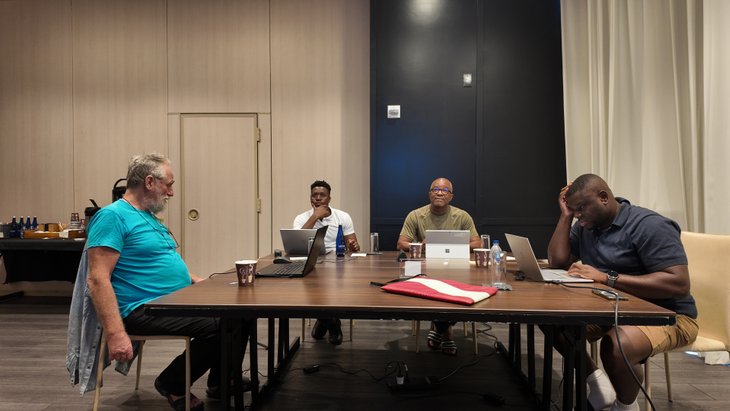
From August 29 to September 3, 2026, representatives of Voie d’Espoir and Plan Kiskeya met in Miami for several days of working sessions focused on the future of the RAPWOCHE/KONEKTE programme. Family tracing, DNA testing, reunions, post-reunion support, data protection and the strengthening of Voie d’Espoir’s capacities were at the heart of the discussions. This strategic meeting took place just a few weeks before an important mission to the Netherlands, where the partners will continue discussions with INEA and other stakeholders involved in origins searches.
For Voie d’Espoir (VE) and Plan Kiskeya (PK), searching for one’s origins does not end when a name appears in a file or when a family is located. It involves verification, preparation, reconnection and, above all, support. It was around this shared vision that Michel Joseph and Dirk Vermeyen, representing Voie d’Espoir, and Judy Aubrain and George Schuddebeurs, representing Plan Kiskeya, met in Miami from August 29 to September 3, 2026. Over several days of working sessions, the two organisations reviewed their collaboration, assessed the mechanisms already in place and discussed the next steps for the RAPWOCHE/KONEKTE programme.
At the heart of the discussions was a conviction that has guided the programme since its creation in 2024: everyone should have the opportunity to know where they come from and, whenever possible, to find their biological family. RAPWOCHE/KONEKTE therefore builds on the complementary strengths of local knowledge in Haiti, international cooperation, the responsible use of DNA and person-centred support for those involved.
From Search to Reunion: A Comprehensive Process
The collaboration between Voie d’Espoir and Plan Kiskeya has gradually developed around a comprehensive continuum of origins-search work. Today, the programme brings together several key components: searching for biological families in Haiti, maintaining and expanding a Reconnection Registry, verifying biological relationships through DNA testing, preparing and facilitating reunions, and providing support after reconnection.
This complementarity is one of the partnership’s key strengths. In Haiti, Voie d’Espoir contributes its knowledge of the country, local communities and family realities. The organisation works directly with families, collects and verifies available information, conducts searches when necessary, supports DNA collection and assists in preparing families for reconnection. Plan Kiskeya, for its part, brings its experience working with adoptees of Haitian origin, particularly in the Netherlands, as well as its expertise and international network.
Across both sides, the objective remains the same: to bridge the distance between adoptees and their family histories while protecting the dignity, consent and individual pace of everyone involved.
A Meeting to Strengthen the Future
The Miami meeting went beyond the follow-up of individual cases. It provided an opportunity for both partners to reflect on how their cooperation should evolve in the coming years.The 2026–2028 period is expected to further professionalise RAPWOCHE/KONEKTE, improve its organisational structure, strengthen transparency and the protection of sensitive data, diversify funding sources and develop a model capable of sustaining search and reconnection activities over the long term. One principle remains clear: professionalisation must never come at the expense of the programme’s deeply human-centred approach.
The discussions therefore focused on four major strategic areas: the programme’s financial sustainability, aftercare following reunions, the development of a secure DNA collection model in Port-au-Prince, and the gradual transfer of certain operational responsibilities to Voie d’Espoir.
This last point represents an important evolution in the partnership. The objective is not to bring the cooperation between the two organisations to an end, but rather to allow it to evolve. Voie d’Espoir is expected to gradually assume greater responsibility for the day-to-day management of RAPWOCHE/KONEKTE in Haiti, while Plan Kiskeya will increasingly strengthen its role as a strategic, supporting and international partner.
From Miami to Amsterdam
The Miami meeting also represents an important preparatory step ahead of Voie d’Espoir’s upcoming European mission. In October 2026, a VE delegation will travel to the Netherlands to continue discussions with partners and other stakeholders involved in origins-search work, with particular attention to meetings with INEA in Amsterdam.
The visit will provide an opportunity to present the progress of the work being carried out in Haiti, share lessons learned through RAPWOCHE/KONEKTE and discuss prospects for cooperation in the years ahead. This international dimension is also part of the programme’s strategic priorities for 2026. The work plan calls for greater international visibility for RAPWOCHE/KONEKTE and stronger relationships and partnerships across Europe.
The Miami meeting has therefore enabled Voie d’Espoir and Plan Kiskeya to approach this next stage with a more structured vision of the priorities, responsibilities and challenges to be discussed with their partners.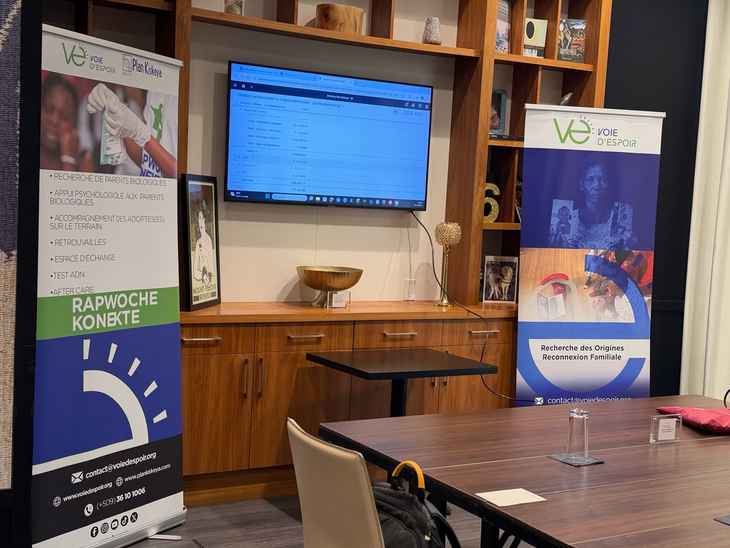
An Evolving Partnership, an Unchanged Mission
Beyond organisational structures, databases, DNA tests and funding strategies, Voie d’Espoir and Plan Kiskeya remain committed to keeping people affected by adoption at the centre of their cooperation. Behind every search is a story. Behind every case file is a person trying to understand where they come from. Behind every DNA sample is the hope of an answer. And behind every family registered in Haiti, there may be a mother, a father, a sister or a brother who has been waiting for years. It is precisely this human dimension that both organisations intend to preserve as their partnership enters a new phase.
The challenge for the coming years is therefore twofold: to professionalise and sustain the programme without losing sight of the very reason it exists.
From Miami to Amsterdam, and above all through the work being carried out on the ground in Haiti, the same conviction continues to guide Voie d’Espoir and Plan Kiskeya: the search for origins is, first and foremost, a search for truth, identity and, when those concerned choose it, connection.