
Intercountry Adoption: Voie d’Espoir Exchanges Perspectives with Organizations from Colombia and Indonesia
Gathered in Zwolle, the Netherlands, at the initiative of INEA’s research team, representatives of organizations working in Haiti, Colombia, and Indonesia shared their experiences, working methods, and the challenges they face in supporting adoptees and biological families in their search for origins.
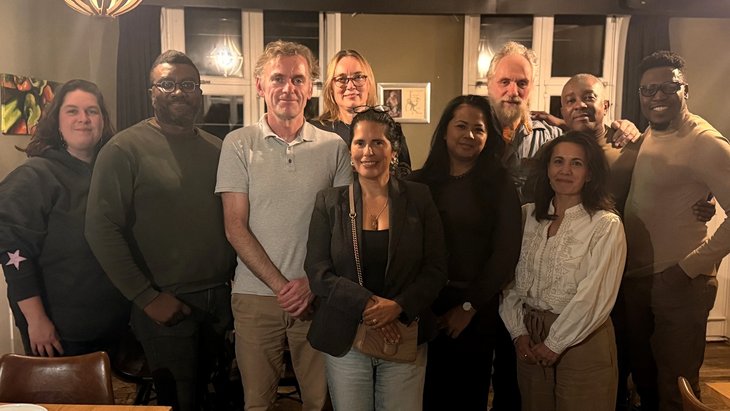
The meeting brought together Fiona Teggatz from Buscas tu Familia in Colombia, Berber Swart and Hanna Knipping from Ibu Indonesia, Judy Aubrain from Plan Kiskeya Netherlands as well as Michel Joseph, Founder and President of Voie d’Espoir, and Dirk Vermeyen.
Beyond institutional presentations, the discussions allowed each organization to reflect on its experience, support methods, challenges encountered on the ground, and the approaches developed to assist individuals undertaking family tracing and searches for their origins.
Different Realities, a Shared Search for Identity
Whether in Haiti, Colombia, or Indonesia, the search for origins raises common questions: How can someone locate their biological family after several decades of separation? How can reliable information be accessed? How can details contained in adoption records be verified? And how can those concerned be supported both when searches are successful and when they remain unanswered?
Although these questions transcend borders, the procedures required to address them vary considerably from one country to another. Legal frameworks, administrative practices, cultural contexts, the availability of archives, identification systems, and access to information are all factors that can either facilitate or complicate the search process.
Added to these differences are individual life stories, the circumstances surrounding family separation, and the sometimes very different expectations of adoptees and their biological families. In the search for origins, no two stories are truly alike. There is no universal approach capable of addressing every situation. It was precisely this diversity that made the meeting in Zwolle particularly valuable.
Learning from One Another to Improve Support
The discussions gave participants an opportunity to discover different approaches, compare experiences, and reflect on practices that could improve support for adoptees and biological families. Beyond investigative methods, the exchanges also highlighted the importance of the human dimension in the search for origins. Reclaiming one’s identity, understanding the circumstances of an adoption, or establishing initial contact with a biological family is far more than an administrative procedure.
These processes can bring back memories, questions, emotional wounds, and feelings that are sometimes difficult to anticipate. They therefore require patience, sensitivity, particular attention to informed consent, and support that respects each person’s individual pace.
For the participating organizations, sharing experiences provided an opportunity not only to enrich their respective practices but also to gain a clearer understanding of the possibilities and limitations of their work.
Voie d’Espoir Highlights the Challenges of Searching for Origins in Haiti
For Voie d’Espoir, the meeting was an important opportunity to present the realities on the ground in Haiti and the particularly complex environment in which the organization carries out its mission. In Haiti, searches for origins face numerous structural obstacles, compounded by a security situation that significantly complicates travel and community-based investigations.
Persistent insecurity restricts access to certain communities, disrupts communications, and sometimes makes it difficult to establish contact with biological families. The issue of archives presents another major challenge. Access to historical documents, their preservation, availability, and the reliability of the information they contain can create significant obstacles for people attempting to reconstruct their personal histories.
Difficulties related to personal identification, variations in the spelling of names, changes of address, and missing administrative information further complicate the search process. In many cases, field teams must rely on testimonies, neighborhood inquiries, cross-checking of information, and sometimes lengthy verification procedures before sufficiently reliable leads can be established.
These challenges are compounded by the vulnerability of some biological families, whose living conditions can make it difficult to access communication tools or the services needed to initiate and continue a search. Despite these obstacles, Voie d’Espoir continues its work identifying and registering biological families, documenting family histories, verifying information, and supporting those concerned.
The organization relies on its teams and collaborators working in different regions of Haiti, as well as partnerships developed through its search-for-origins projects.
International Cooperation: An Essential Driver
The meeting in Zwolle served as a reminder that the search for origins cannot be approached solely within national boundaries. Adoptees often live thousands of kilometers away from their countries of birth, while the information needed to understand their histories may be scattered across multiple institutions, archives, and territories.
Cooperation between stakeholders in countries of origin and those in receiving countries is therefore essential to facilitate access to information, improve research methods, and develop appropriate support mechanisms. Exchanges with organizations working in Colombia and Indonesia helped place the challenges encountered in Haiti into a broader perspective while offering insights into other experiences and field-based approaches.
These meetings are not intended to standardize research methods, but rather to foster a better understanding of differences, share good practices, and build bridges between organizations facing sometimes similar challenges in profoundly different contexts.Through this new stage of its European mission, Voie d’Espoir continues its commitment to making the search for origins more accessible, more rigorous, and more responsive to the needs of those concerned.
Because beyond differences in legislation, culture, or social context, one shared aspiration unites those engaged in these journeys: to understand their history, recover traces of their past, and, whenever possible and desired, reconnect with their families.
VE