
Voie d’Espoir in the Netherlands: An Important Meeting with INEA and Plan Kiskeya on the Search for Origins
Voie d’Espoir’s mission to the Netherlands reached an important milestone on Monday, October 19, 2026, with its first major institutional meeting with INEA and Plan Kiskeya, dedicated to the search for origins and family reconnection.
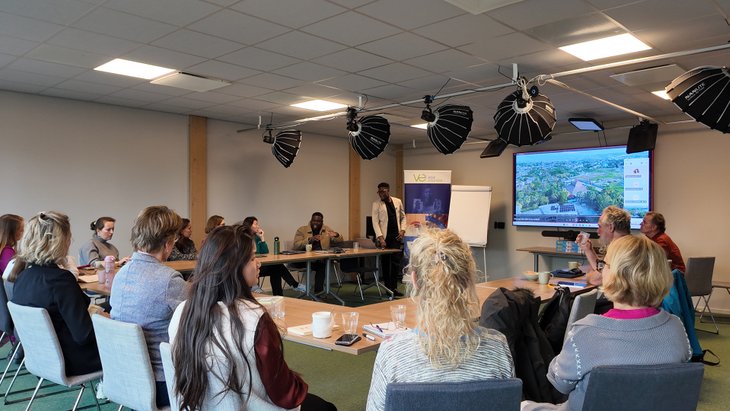
The meeting brought together members of INEA’s Board of Directors, the Plan Kiskeya team, and representatives of the Dutch Ministry of Justice, who joined the discussions online.
INEA (Identiteit, Nazorg, Erkenning en Adoptievraagstukken) is the Dutch Expertise Centre on Intercountry Adoption. Established at the initiative of the Ministry of Justice and Security, it serves as a national centre providing information, guidance, and support to internationally adopted people, particularly in their search for origins, access to adoption records, and need for psychosocial and legal assistance.
The discussions focused on the right to know one’s origins, access to identity information, the search for biological families, and the support mechanisms available to adoptees seeking answers and wishing to reconnect with their personal histories. The meeting also provided an opportunity for Michel Joseph, journalist and founder of Voie d’Espoir, and Dirk Vermeyen to present the Haitian organization, its history, mission, working methods, achievements, and the challenges it faces in carrying out its work in Haiti.
Officially established in September 2020, Voie d’Espoir traces its origins to a series of journalistic investigations conducted in 2015 into international adoption in Haiti. These investigations notably documented the testimonies of biological families who had lost contact with their children adopted abroad.
Particular attention was given to the RAPWOCHE/KONEKTE project, implemented by Voie d’Espoir in collaboration with Plan Kiskeya and funded by INEA. The initiative aims to identify and register biological families, document their stories, facilitate searches through field investigations and DNA testing, and support potential reunions while respecting consent, confidentiality, and each person's individual pace.
Beyond presenting the activities, the meeting provided an opportunity for evaluation, reflection, and dialogue. Assessing progress, analyzing methods, questioning practices, understanding realities on the ground in Haiti, and discussing the project's future were all essential steps in measuring achievements and identifying areas for improvement.
These discussions are particularly significant in the Netherlands, where approximately 40,000 children from around 80 countries, including Haiti, have been adopted internationally over recent decades.
The Netherlands Confronts Its History of Intercountry Adoption
For several years, intercountry adoption in the Netherlands has been the subject of considerable scrutiny and reassessment. In February 2021, an independent commission chaired by Tjibbe Joustra published a report exposing serious failures and abuses in international adoption procedures, including document falsification, administrative irregularities, fraud, and practices that in some cases amounted to child trafficking.
The investigation, primarily covering the period from 1967 to 1998, examined adoptions from several countries of origin, including Bangladesh, Brazil, Colombia, Indonesia, and Sri Lanka. It also highlighted inadequate oversight and the failure of Dutch authorities to respond appropriately to reports of abuse. Following these revelations, the Dutch government issued an official apology and suspended new intercountry adoption procedures in February 2021.
After certain procedures were allowed to resume under stricter conditions, the authorities announced in May 2024 that no new adoption procedures would be initiated. In December of the same year, they outlined plans to phase out intercountry adoption over six years, with the process scheduled to conclude by the end of 2030. At the same time, measures were introduced to improve access to adoption records, facilitate searches for origins, and strengthen support for adoptees affected by irregular adoption practices.
And in Haiti, Who Will Shed Light on International Adoptions?
These developments raise a fundamental question: What about Haiti, a country of origin for thousands of children adopted abroad?
While authorities in several receiving countries, adoptees, and various international stakeholders are intensifying efforts to understand past practices, establish accountability, and promote access to the truth, these issues remain largely absent from institutional priorities and public debate in Haiti. Yet there is no shortage of questions.
Under what circumstances were thousands of Haitian children placed for international adoption over the decades? Did adoption procedures always respect the rights of children and their biological families?What roles were played by intermediaries, adoption agencies, and the institutions responsible for overseeing them? What has become of the records that could now help these individuals reconstruct their personal histories?And what answers can be offered to families who say they were separated from their children without fully understanding the consequences of their decisions?
These questions do not, in themselves, constitute accusations. They call for documented answers based on independent, rigorous, and transparent investigations.Haiti cannot simply remain a country of origin in adoption records while standing on the sidelines of international debates about truth, accountability, and reparations.
Born out of a journalistic initiative in 2015, Voie d’Espoir continues its commitment today through research, mediation, and support for adoptees and biological families. But beyond individual reunions, a broader collective question remains: the need to document this history, preserve its memory, and ensure that those concerned can access the information that rightfully belongs to them. Because behind every adoption lies a story. And behind some of those stories are questions that have yet to receive meaningful answers.