
Voie d’Espoir Joins the Haitian Community in the Netherlands to Honor Dessalines
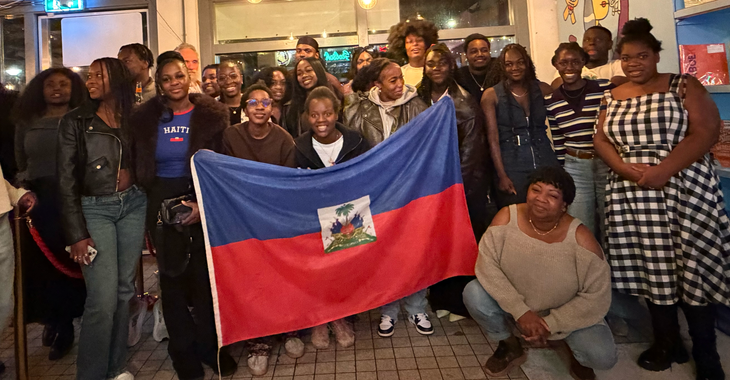
Amsterdam, Netherlands, October 17, 2026 — The first day of Voie d’Espoir’s European tour coincided with the commemoration of the 220th anniversary of the assassination of Jean-Jacques Dessalines, the founding father of Haitian independence. This highly symbolic date gave special significance to the organization’s first stop in the Netherlands, marked by meaningful encounters, discussions, and reflections on history, identity, and the search for origins.
At the initiative of Ayiti KonViv, members of the Haitian community, Haitian-born adoptees, and several guests gathered in Amsterdam for a day of remembrance and exchange. Voie d’Espoir was represented by Michel Joseph, its Founder and President, and Dirk Vermeyen, a member of the organization’s team and a committed partner in family origins research.
The program included an opening ceremony, a screening of the film Toussaint Louverture, followed by discussions with participants, as well as a presentation on roots journeys and DNA testing, with the participation of Plan Kiskeya. Beyond paying tribute to Jean-Jacques Dessalines, the event provided a valuable opportunity for dialogue between Haitian-born adoptees and Voie d’Espoir.
For many adoptees, the question of origins carries particular significance. Some have not yet had the opportunity to return to Haiti since their adoption, yet they express a deep interest in their personal histories, their culture, and the country where they were born.

Voie d’Espoir Listens to Haitian-Born Adoptees
The gathering gave Michel Joseph an opportunity to revisit Voie d’Espoir’s mission: supporting adoptees and biological families in their search for origins and efforts to reconnect with family members. He outlined the organization's main areas of work, including registering biological families, conducting documentary research and field investigations, facilitating DNA testing in collaboration with specialized partners, providing family mediation, and supporting adoptees before, during, and after their search.
Special attention was also given to supporting adoptees who wish to travel to Haiti to discover their country of birth, pursue their research, or, when circumstances allow, meet members of their biological families.
The discussions provided an opportunity to address participants’ questions, particularly regarding the reliability of family tracing efforts, the possibilities offered by DNA testing, the steps involved in initiating a search, and the precautions necessary before considering a potential reunion. Above all, these conversations highlighted a strong interest in Haitian history and culture, as well as a clear need for information, guidance, and support throughout the search for origins.
For Voie d’Espoir, these exchanges reaffirm the importance of building bridges between Haiti and communities of Haitian-born adoptees living abroad, while respecting each individual's expectations, choices, and personal pace.
A European Tour Focused on Dialogue and Cooperation
This first stop in the Netherlands marks the beginning of a series of meetings that Voie d’Espoir plans to continue across Europe. The mission’s agenda includes institutional meetings with technical partners, organizations involved in family origins research, adoptee communities, and representatives of public authorities.
Through this initiative, Voie d’Espoir aims to strengthen existing partnerships, explore new opportunities for cooperation, and raise awareness of its work among those affected by international adoption from Haiti.The organization also intends to continue improving family tracing mechanisms, strengthening support for biological families, and facilitating adoptees’ access to reliable information about their personal histories.
As this meaningful and emotional day came to a close, discussions also turned toward upcoming initiatives within the Haitian community in the Netherlands. Following this commemoration honoring the memory of Dessalines, Ayiti KonViv and the Haitian community are now looking ahead to next year’s Haitian Carnival, another opportunity to celebrate and promote Haiti’s culture, traditions, and heritage within the diaspora.
This first day of the European tour was far more than a community gathering. It once again demonstrated how deeply the desire to understand one's history and preserve one's roots remains alive, even thousands of kilometers away from Haiti. For although life's journeys may take people far from their homeland, the search for origins continues to build connections across generations, families, and continents.